Naive Doodle Animator
Turning one sentence into keyframes and reusable hand-drawn motion assets for short-video overlays.
Context
Designed a text-driven multi-frame animation workflow to reduce the cost of frame-by-frame doodle production and improve AI style and character consistency.
AI Workflow
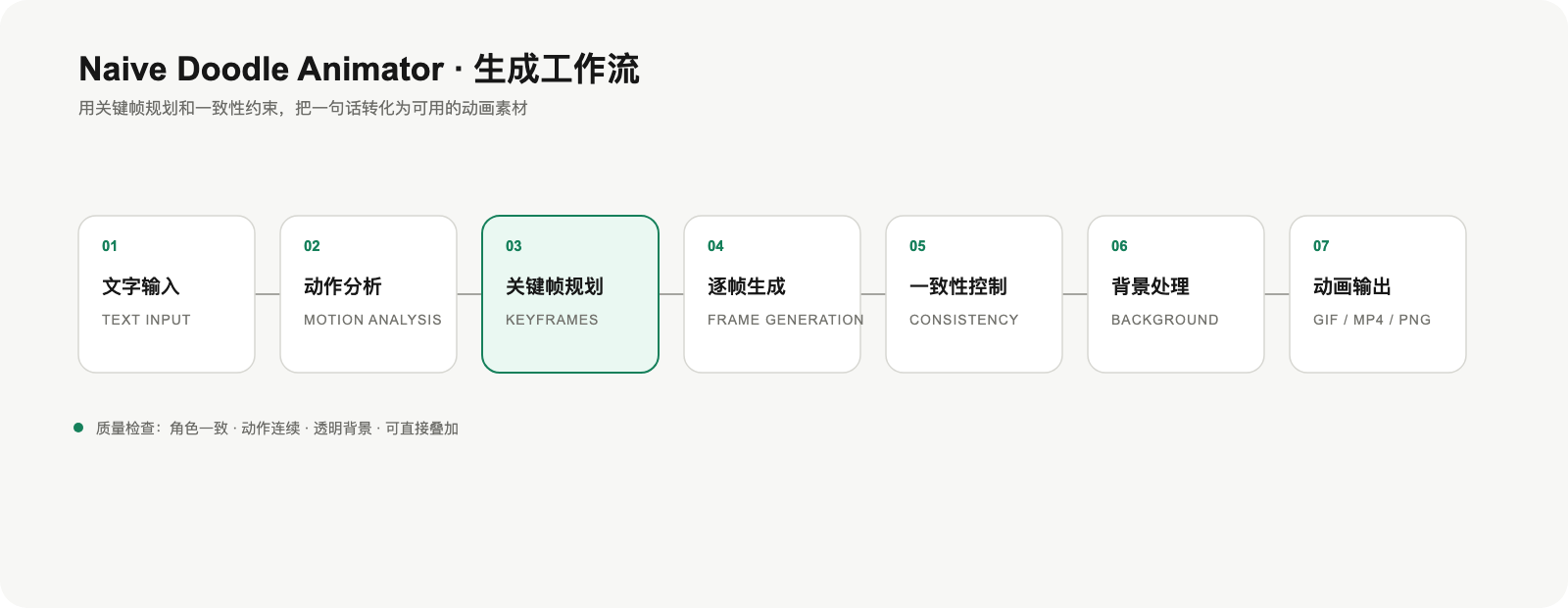
Decomposed natural-language descriptions into motion analysis → keyframe planning → frame generation → style-consistency control → background processing → animation output, with fixed visual rules for naive linework, paper texture and frame-by-frame boiling motion.
Outcome
Packaged the generation rules as a reusable skill and specified transparent PNG sequences, sprite sheets, GIF and MP4 assets for video-overlay workflows.
context
The project serves video post-production: an editor enters one Chinese or English sentence and receives stylistically consistent doodle-animation assets.
Keep input simple and make outputs ready for the video-production pipeline.problem
Frame-by-frame doodle animation is expensive to produce, while generic AI outputs often drift in style, character identity and motion continuity.
Efficiency and consistency must be solved together.insight
Direct frame-by-frame generation is difficult to control. Motion analysis and keyframe planning must come first, followed by generation under fixed visual rules.
Keyframe planning determines motion logic; consistency constraints determine usability.solution
Designed a text-driven multi-frame workflow that translates natural language into motion, keyframes and deliverable animation files.
One sentence in, production-ready animation assets out.product design
Specified transparent PNG sequences, sprite sheets, GIF and MP4 outputs, including transparent-background and sizing requirements for video overlays.
The output is not a preview image, but an asset package ready for editing software.ai workflow
Natural language is decomposed into: text input → motion analysis → keyframe planning → frame generation → consistency control → background processing → animation output.
Keyframe planning and consistency constraints turn one sentence into usable animation assets.build
Packaged the generation rules as a reusable skill, fixing visual rules such as naive linework, paper texture and frame-by-frame boiling motion.
Style rules live inside the workflow instead of being rewritten for every request.validation
Quality checks focus on character consistency, motion continuity, transparent backgrounds and overlay readiness.
Both output format and visual consistency determine whether the asset is genuinely usable.results
Completed a reusable skill specification and defined output paths for transparent PNGs, sprite sheets, GIF and MP4.
The outcome is a reusable animation-generation method and delivery specification.reflection
The hard part is not single-frame quality but cross-frame continuity and production use. The next step is broader motion coverage and stability testing across characters and aspect ratios.
Moving from generation to delivery means treating consistency and file formats as product-design concerns.